OUT OF OFFICE

Running an architecture or engineering firm can make it feel as though the most responsible place to be is always in the office—answering emails, reviewing projects, managing deadlines, and preparing for whatever comes next.

But some of the most valuable work we do happens when we step away.

OoO—Out of the Office—is a chronicle of travel, exploration, and the lessons that emerge when we leave our familiar routines behind. It is not intended simply as a record of destinations visited. It is a reminder that getting outside our businesses is an important part of becoming better designers, leaders, and firm owners.

Travel expands the library of experiences we bring to our work. It exposes us to different communities, cultures, landscapes, building traditions, infrastructure systems, and ways of solving problems. It gives us opportunities to see how people respond to climate, geography, limited resources, changing economies, and the natural environment.

It also restores perspective.

Architecture and engineering require curiosity, observation, empathy, and imagination. Those qualities can be difficult to sustain when every day is consumed by schedules, budgets, staffing challenges, and client demands. Time away creates the space to notice again—to study how a city meets the water, how a road follows the land, how people gather, and how natural forces shape the places we inhabit.

Getting out of the office is not an escape from the work. It is an investment in the knowledge, creativity, energy, and perspective we bring back to it.
ALASKA: JUNE 2026

Perspective Under the Midnight Sun

My first trip to Alaska began on June 22, 2026, just after the summer solstice.

I arrived expecting mountains, glaciers, wildlife, and dramatic scenery. Alaska delivered all of that, but what stayed with me most was the scale of the place—and the way the natural environment influences nearly every decision involving settlement, infrastructure, transportation, and daily life.

Although Juneau and Anchorage do not experience a literal 24 hours of sun, daylight feels nearly continuous this time of year. Juneau receives more than 18 hours of direct sunlight near the solstice, while Anchorage experiences more than 19 hours of sunlight and roughly 22 hours of usable daylight. The extended twilight makes it difficult to recognize when one day has ended and another has begun.

For someone accustomed to organizing life around schedules, working hours, and deadlines, there was something freeing about a day that seemed unwilling to end.

Juneau: A City Defined by Its Setting

I began the trip by exploring historic downtown Juneau. The city is compressed between the mountains and Gastineau Channel, creating a close relationship between its buildings, streets, waterfront, and surrounding landscape.

Juneau is also the only state capital in the country that cannot be reached by road. Access is by air or water, even though the community itself contains approximately 190 miles of local roads. That geographic isolation influences logistics, construction, commerce, tourism, and the movement of people and materials.

For architects, engineers, and business owners, Juneau is a powerful example of how constraints shape a place. The mountains and water are not simply scenery surrounding the city. They are active forces that determine where development can occur, how infrastructure functions, and how the community connects with the rest of the world.

Downtown, multiple cruise ships were docked along the waterfront, releasing thousands of visitors into a relatively compact district. Within a short period, the streets, shops, restaurants, and sidewalks filled with people. It was a visible demonstration of the pressure that seasonal demand can place on a community—and of the economic opportunities that accompany it.

While visiting local breweries and enjoying Alaskan halibut and salmon, I spoke with seasonal employees who had traveled from countries including Romania and Greece to work during the summer tourism season. Their presence was another reminder that the operations behind a successful destination extend far beyond its buildings. Workforce availability, temporary housing, transportation, training, and cultural integration all contribute to the visitor experience.

A well-designed place is only as successful as the human systems that allow it to function.

Where Mountains Meet the Water

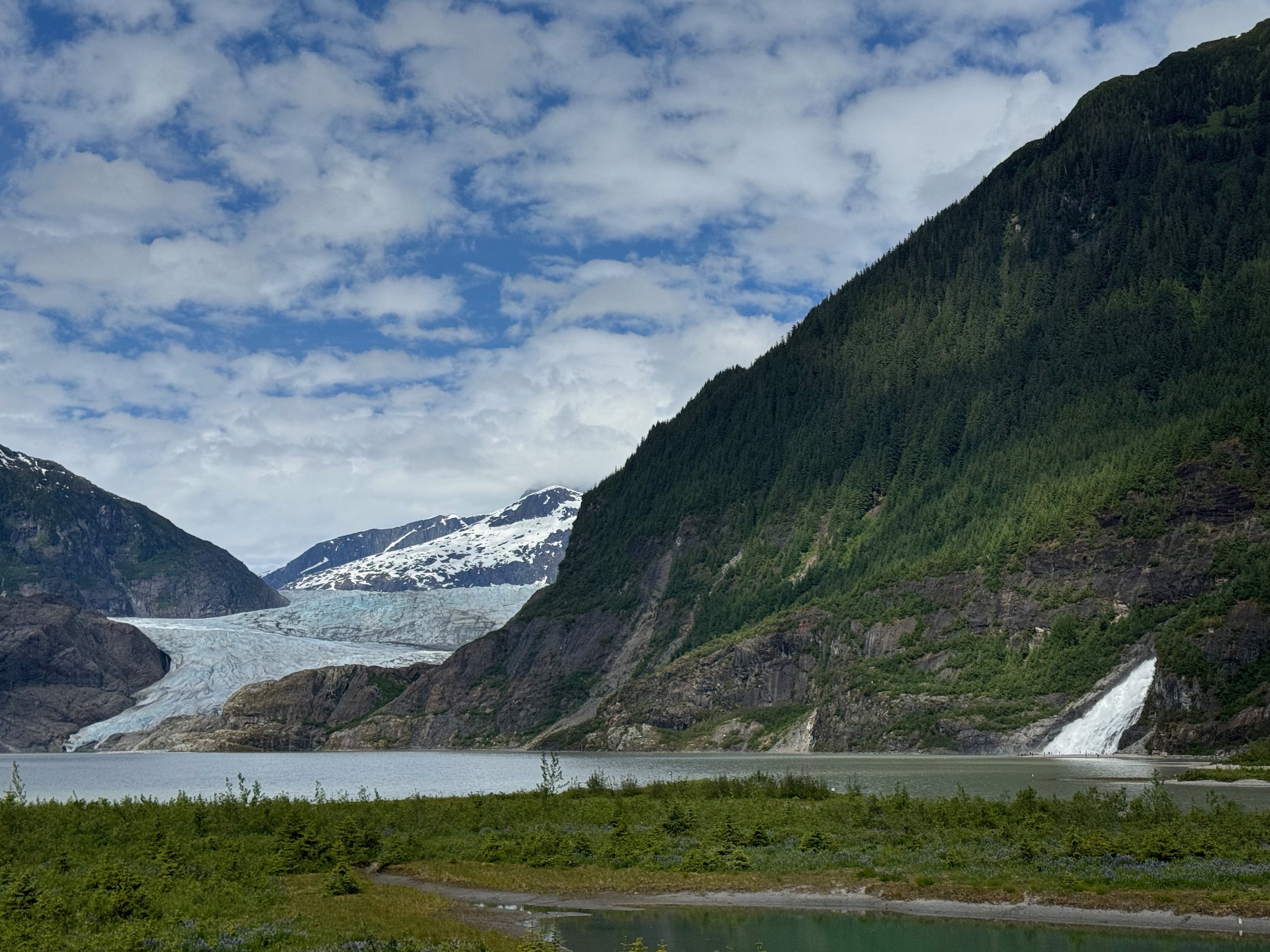
Traveling north along the coastline, I watched waterfalls descend from the mountains and empty directly into Gastineau Channel. Water appeared everywhere—falling from cliffs, moving through streams, collecting in lakes, forming glaciers, and defining transportation routes.

Juneau sits within the Tongass National Forest, the largest national forest in the United States. Covering nearly 17 million acres, the Tongass includes temperate rainforest, glaciers, islands, fjords, waterways, and the peaks of the Coast Mountains.

The experience reinforced a basic design principle that is easy to acknowledge but sometimes difficult to practice: context is not the background of a project. Context is one of the project’s primary clients.

In Alaska, the land does not politely accommodate human plans. Buildings, roads, utilities, and communities must respond to steep terrain, heavy precipitation, snow, ice, tides, wildlife, limited access, and immense distances. The environment establishes the terms.

Mendenhall Glacier and the Evidence of Change

On June 23, we visited Mendenhall Glacier and Mendenhall Lake.

Mendenhall Glacier is a roughly 13-mile-long river of ice connected to the approximately 1,500-square-mile Juneau Icefield. It terminates at Mendenhall Lake, where icebergs can be seen floating against the backdrop of mountains and forest.

Standing near the glacier creates a different understanding of time. Buildings are often discussed in terms of decades. Businesses may plan in one-, three-, or five-year increments. Glaciers reveal change measured over centuries—yet they also make environmental change visible within a human lifetime.

For design professionals, the lesson is not simply that conditions change. It is that we must design with change in mind.

Climate, technology, demographics, energy use, material availability, and client needs will continue to evolve. The most responsible solutions are not those that assume permanence, but those that can adapt, endure, and remain useful as circumstances shift.

Humpback Whales in Auke Bay

Later that day, we spent time whale watching in Auke Bay.

Seeing humpback whales moving through the water was one of the most memorable experiences of the trip. Their size was difficult to comprehend, particularly when most of the animal remained below the surface.

Humpbacks migrate to Alaska each spring to feed in its nutrient-rich waters and build energy reserves throughout the summer. In the fall, they return to warmer waters near Hawaii, Mexico, and other areas of the Pacific to breed and give birth. Yet, their distinctive marks allowed the trained guides and environmentalists to identify them by name, often simply by the markings on the underside of their majestic and powerful tales.

That cycle is an extraordinary natural system—one that connects distant regions, seasons, food sources, weather patterns, and generations.

Architecture and engineering firms operate within systems as well. Projects, clients, employees, consultants, markets, and financial resources are interconnected. What appears to be a single decision may affect many other parts of the organization.

The whales were a reminder to look beyond the visible moment and understand the larger system moving beneath the surface.

Anchorage: Nature and Engineering in the Same View

On June 24, we flew from Juneau to Anchorage.

That afternoon, we visited 49th State Brewing in downtown Anchorage. From its rooftop patio overlooking Cook Inlet and the Alaska Range, an unusually sunny and clear day provided a distant view of Denali. The mountain was visible on the horizon, enormous even from many miles away.

At the same time, F-22 Raptors conducted training flights over Knik Arm. Joint Base Elmendorf-Richardson, located near Anchorage, is home to the U.S. Air Force’s 3rd Wing and its F-22 operations.

The scene brought together two very different expressions of power and precision: the immense natural presence of the Alaska Range and one of the most advanced aircraft ever engineered.

For those of us in the design professions, it was an impressive contrast. One represented forces shaped over geologic time. The other represented the accumulated knowledge, experimentation, coordination, and technical achievement of thousands of people.

Both were reminders of what exists beyond the scale of our daily concerns.

The Seward Highway and Turnagain Arm

On June 25, we drove south from Anchorage along the Seward Highway toward Girdwood.

For roughly its first 50 miles, the highway follows the base of the Chugach Mountains and the shoreline of Turnagain Arm. The route is recognized as an Alaska Scenic Byway, a National Forest Scenic Byway, and an All-American Road.

Snowcapped mountains rose almost directly from the ocean. The highway and adjacent railroad occupied a narrow band of land between steep slopes and tidal water. Waterfalls appeared along the mountainsides, while the road curved in response to the shoreline.

It was unlike anything I had experienced elsewhere in North America.

The drive demonstrated how infrastructure can do more than connect two destinations. It can reveal a landscape.

The Seward Highway does not overpower its setting. It follows it, frames it, and allows travelers to understand the relationship between mountain, water, weather, and distance. The experience is a lesson in restraint: sometimes the best design decision is not to impose a new order, but to recognize and strengthen the order that is already present.

Returning with a Larger Frame of Reference

Alaska reminded me that leaving the office is not about abandoning responsibility. It is about returning to our responsibilities with a larger frame of reference.

Firm ownership naturally pulls our attention inward. We focus on proposals, utilization, staffing, profitability, schedules, and the immediate problems waiting to be solved. Those things matter. But when our field of vision becomes too narrow, our thinking can become narrow as well.

Travel interrupts that pattern.

It exposes us to unfamiliar constraints. It restores our sense of scale. It gives us new examples of resilience, adaptation, infrastructure, community, and beauty. It fills the creative reservoir from which future ideas will emerge.

I returned from Alaska with photographs and memories, but also with renewed curiosity. I came back thinking differently about context, natural systems, transportation, change, and the relationship between human ambition and the environment.

That is the purpose of getting out of the office.

Not simply to see somewhere new—but to return capable of seeing our work, our businesses, and our world differently.