
Are We Charging Enough…Too Much?
How To Calculate Overhead & Billing Rates
One of the most difficult questions for architecture and engineering firm leaders is also one of the most basic:
Are we charging enough?
The answer is rarely obvious.
Unlike products sold in a store, professional design services do not come with a clearly posted market price. Every project is different. Every client has different expectations. Every firm has a different mix of experience, expertise, overhead, staffing, and risk.
That makes determining appropriate billing rates more complicated than simply asking what another firm charges.
The architecture and engineering profession does not make this any easier. Firms are often very tight-lipped about fees, hourly rates, multipliers, and profitability. Leaders may hear anecdotal information from peers, consultants, or former employees, but reliable comparisons are difficult to find.
As a result, many firms develop rates based on habit rather than analysis.
They may increase last year’s rates by a few percentage points. They may copy rates from a competitor. They may choose numbers that feel acceptable to clients. Or they may avoid increasing rates because they are concerned about appearing too expensive.
None of those approaches answers the most important question:
What does your firm need to charge to support its people, cover its operating costs, and generate a reasonable profit?
Your Rates Must Start with Your Firm
Every firm has a unique financial structure.
Your billing rates must account for employee compensation, payroll taxes, benefits, rent, software, insurance, marketing, administration, professional development, technology, nonbillable time, and the many other costs required to operate a design practice.
They must also provide enough margin to create profit.
Profit is not simply money left over at the end of the year. It allows a firm to build cash reserves, invest in technology, reward employees, withstand economic uncertainty, recruit talented people, and plan confidently for the future.
A firm can remain extremely busy and still struggle financially when its rates do not reflect the true cost of delivering its services.
That is why billing rates should begin with your own financial information—not a competitor’s rate sheet or an assumption about what the market might tolerate.
Can Billing Rates Be Too High?
Of course, every market has limits.
Clients have budgets, expectations, and alternative firms they can hire. Rates that are significantly higher than those of comparable providers may create resistance, particularly when clients view competing services as interchangeable.
But that does not mean the lowest rate wins.
Many clients are willing to pay more for experience, responsiveness, specialized knowledge, reduced risk, stronger project management, better communication, and a more predictable outcome.
The problem is that architecture and engineering firms often struggle to clearly communicate those differences.
When the conversation focuses only on hourly rates, design services can appear to be a commodity. A principal at one firm may look expensive compared with a principal at another firm, even though the first may solve problems more quickly, anticipate risk, improve decisions, and create significantly greater value for the client.
An hourly rate measures the cost of time. It does not fully measure the value of expertise.
Move the Conversation from Cost to Value
Design services are not goods.
Clients are not simply purchasing hours. They are purchasing judgment, creativity, technical knowledge, coordination, advocacy, problem-solving, and risk management.
A well-designed project can improve operations, support employee recruitment, reduce energy use, strengthen an institution’s identity, enhance learning, increase revenue, or avoid costly mistakes during construction.
Those outcomes are worth far more than the individual hours required to produce them.
Firm leaders must become better at connecting fees to the value provided. That means clearly defining outcomes, explaining risk, demonstrating relevant experience, and helping clients understand what strong professional services make possible.
However, communicating value does not eliminate the need to understand your costs.
Value should shape how you position and sell your services. Financial analysis should determine the minimum level at which those services can be delivered sustainably.
Both are necessary.
Rates Are Only Part of the Equation
Healthy billing rates do not automatically create profitable projects.
Fees must also be based on realistic assumptions about scope, schedule, staffing, and effort. Project managers must monitor budgets, control scope creep, invoice consistently, and address problems early.
A strong rate applied to an under-scoped project can still result in a loss.
Likewise, a competitive fixed fee can be profitable when the project is well planned, efficiently staffed, and carefully managed.
Billing rates are not the entire business model, but they are one of its most important foundations.
Replace Guesswork with Clarity
Firm leaders should be able to explain how their rates were developed.
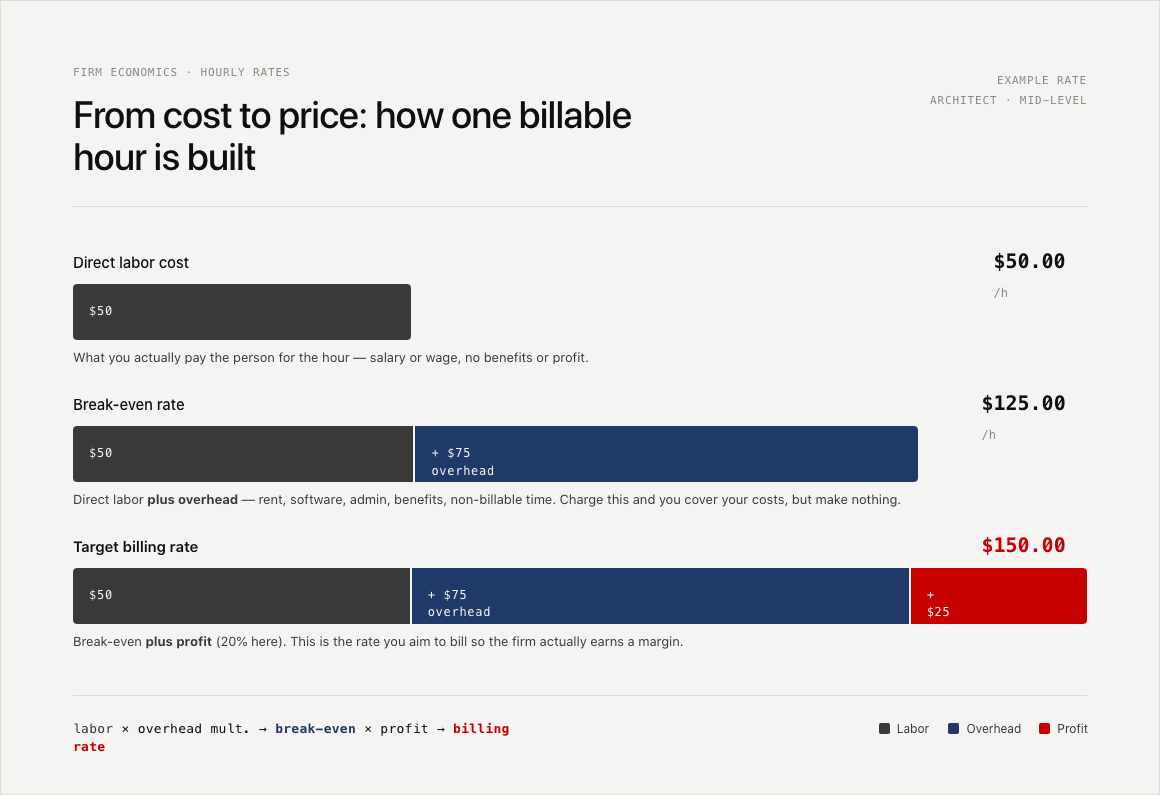
They should understand how direct labor, employee benefits, overhead, utilization, and targeted profit work together. They should also be able to test different financial scenarios before approving annual rate increases or negotiating significant contracts.
The AOS Overhead and Billing Rate Calculator was created to help firm leaders do exactly that.
Rather than relying on generic industry benchmarks, the calculator uses your firm’s own financial information to help determine appropriate overhead, break-even, and target billing rates.
It allows you to see how changes in salaries, expenses, utilization, or profit goals affect what your firm needs to charge.
You may still need to consider your market, your clients, and the value of your expertise. But you will no longer be making those decisions without understanding the financial consequences.
Your billing rates should not be based on guesswork, fear, or what another firm happens to charge.
They should be grounded in the reality of your business.
Purchase the AOS Overhead and Billing Rate Calculator and build billing rates that support your people, your clients, and the long-term health of your firm.