
We Can Do That…Can We Win It?
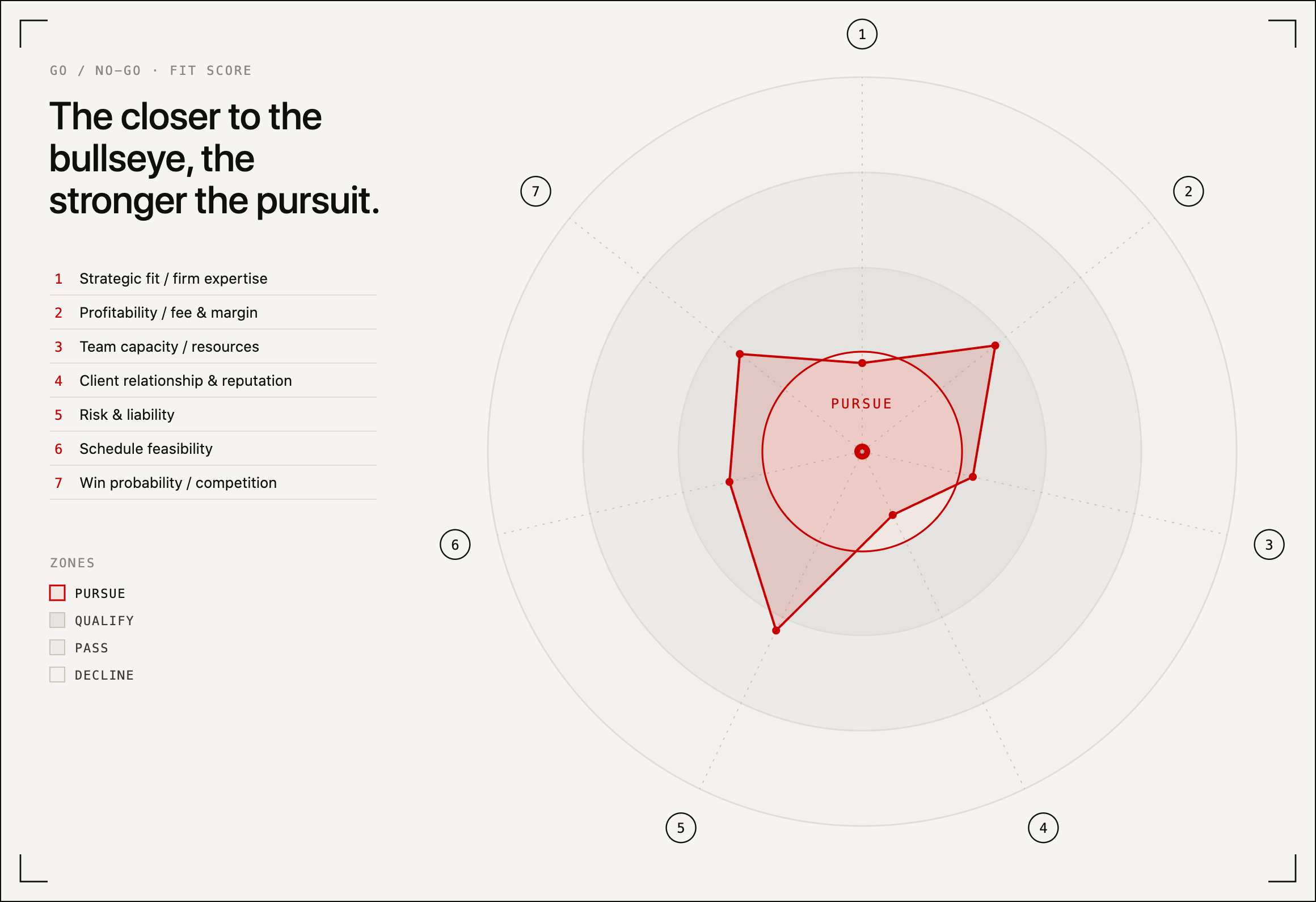
GO/No-Go Decisions For Better Pursuits
Architects and engineers are naturally optimistic about their ability to solve problems.
When a new project opportunity appears, our first reaction is often to imagine what the project could become. We see the design potential, begin forming ideas, and convince ourselves that our team could do exceptional work.
In many cases, we probably could.
But being capable of completing a project does not necessarily mean the firm should pursue it.
One of the most important disciplines in running a successful architecture and engineering practice is knowing when to say yes—and when to walk away.
That decision can be difficult because every opportunity carries possibility. A new client could lead to a long-term relationship. A project in a new market could expand the firm’s portfolio. A high-profile pursuit could strengthen the firm’s reputation.
It is easy to focus on what might be gained while overlooking the time, cost, risk, and disruption involved in pursuing the work.
That is why firms need an objective and disciplined go/no-go process.
Every Pursuit Has a Cost
Responding to a request for qualifications or proposal requires a significant investment.
Marketing staff, principals, project managers, technical leaders, and designers may all contribute to the response. The team may spend hours reviewing requirements, developing strategy, selecting projects, writing narratives, coordinating consultants, preparing graphics, rehearsing presentations, and attending interviews.
That effort often pulls professional staff away from billable project work.
Even a relatively straightforward pursuit can represent thousands of dollars in labor. A major proposal and interview effort can easily cost tens of thousands of dollars.
When the firm does not win, that investment cannot be recovered.
This does not mean firms should avoid competition. Pursuing new work is necessary for growth and long-term stability. But it does mean that every opportunity should earn the right to receive the firm’s time and attention.
Capability Is Not the Same as Strategic Fit
The first question is not simply, “Can we do this project?”
The better question is, “Should this project be part of the firm we are trying to build?”
A project may be technically within the firm’s capabilities but still be poorly aligned with its strategic goals. It may be located outside the firm’s desired geography, fall within a market the firm does not intend to grow, require expertise the team cannot clearly demonstrate, or distract leadership from more important opportunities.
Strategic fit matters because every project shapes the future of the practice.
The clients you serve, the project types you pursue, and the experience you build influence the opportunities you will receive next.
A disciplined pursuit process helps ensure the firm is not simply chasing revenue, but intentionally building the portfolio, expertise, and relationships it wants for the future.
Evaluate the Full Opportunity
A thoughtful go/no-go decision should consider several factors.
Strategic Fit and Expertise
Does the project align with the firm’s strategic plan, target markets, geographic goals, and long-term vision?
Does the firm have relevant experience and a credible story to tell? If not, is there a clear reason to invest in entering this market or project type?
Wanting to do a project is not the same as being well positioned to win it.
Profitability Potential
Is the client likely to value professional services, or will the selection be driven primarily by the lowest fee?
Does the anticipated scope appear realistic? Is the project adequately funded? Are there warning signs that the schedule, complexity, or client expectations could require significantly more effort than the fee will support?
Winning an unprofitable project does not strengthen the firm.
A pursuit should be evaluated not only for its potential revenue, but also for its likelihood of producing an appropriate return for the effort, expertise, and risk involved.
Team and Firm Capacity
Does the firm have the people available to pursue and deliver the project successfully?
A new project may appear attractive, but the firm must consider its current backlog, staff utilization, leadership availability, consultant capacity, and upcoming deadlines.
Overloading a team can damage existing client relationships, reduce project quality, create burnout, and place pressure on profitability.
The pursuit team should also be realistic about whether key staff can make the proposal and interview effort required to compete effectively.
Client Relationship and Reputation
Does the firm have an existing relationship with the client?
Has the client demonstrated trust in the firm, shared useful information, or encouraged the team to pursue? Does the firm understand the client’s priorities and decision-making process?
It is also important to evaluate the client’s reputation.
Do they make timely decisions, honor agreements, pay invoices, manage scope responsibly, and treat professional teams fairly? Or are they known for unrealistic expectations, frequent disputes, delayed payments, and repeated scope changes?
A prestigious project does not always mean a healthy client relationship.
Risk and Liability
Every project carries risk, but some carry significantly more than others.
The firm should consider project type, delivery method, contractual terms, technical complexity, consultant responsibilities, construction budget, schedule, and potential life-safety exposure.
Leaders should ask whether the firm has the experience, insurance coverage, quality-control systems, and consultant team necessary to manage the risk appropriately.
The potential reward should be evaluated in relation to the potential liability.
Schedule Feasibility
Can the project realistically be completed within the client’s proposed schedule?
An aggressive schedule may require additional staffing, overtime, accelerated consultant coordination, or greater exposure to errors and omissions.
The firm should also consider whether the client has allowed enough time for programming, decision-making, agency approvals, procurement, and construction.
Accepting an impossible schedule rarely ends well. The firm may be blamed for delays that were built into the project before the design team was selected.
Probability of Winning
This may be the most important and most uncomfortable question:
What is the firm’s actual probability of winning?
Not whether the firm could do a great job. Not whether the team likes the project. Not whether the opportunity would look good on the website.
What is the realistic probability that the client will select the firm over the likely competition?
The answer should consider existing client relationships, incumbent firms, relevant experience, geographic presence, team qualifications, consultant strength, known competitors, selection criteria, and any insight into how the opportunity developed.
A firm should be cautious when it has no client relationship, no clear competitive advantage, limited relevant experience, and no understanding of why it was invited to compete.
Optimism is not a pursuit strategy.
A “No” Decision Can Be Strategic
Passing on a project can feel like a missed opportunity.
In reality, a no-go decision can be one of the most strategic choices a firm makes.
It protects billable time. It preserves staff capacity. It reduces unnecessary risk. It allows marketing and leadership resources to focus on opportunities with stronger alignment and a higher probability of success.
It also creates space for the firm to invest in existing clients, improve project delivery, develop staff, and pursue work that better supports its long-term goals.
The purpose of a go/no-go process is not to eliminate ambition or discourage growth.
It is to make sure the firm’s ambition is focused.
Replace Enthusiasm with Disciplined Judgment
A strong pursuit decision should not depend on the loudest voice in the room, the excitement surrounding the project, or a principal’s instinct alone.
It should be based on consistent criteria that allow leadership to compare opportunities, identify concerns, challenge assumptions, and make informed decisions.
The AOS Go/No-Go Decision Matrix was created to bring structure and objectivity to this process.
The tool helps firm leaders evaluate strategic fit, experience, profitability, capacity, client relationship, risk, schedule, competitive position, and probability of winning. It creates a clear framework for discussing whether an opportunity deserves the firm’s investment.
Your team may be capable of doing excellent work on almost any project.
The more important question is whether pursuing that project is the best use of your firm’s time, talent, and resources.
Purchase the AOS Go/No-Go Decision Matrix and make your next pursuit decision with greater clarity, consistency, and confidence.