
I’m a Firm Leader…Now What?
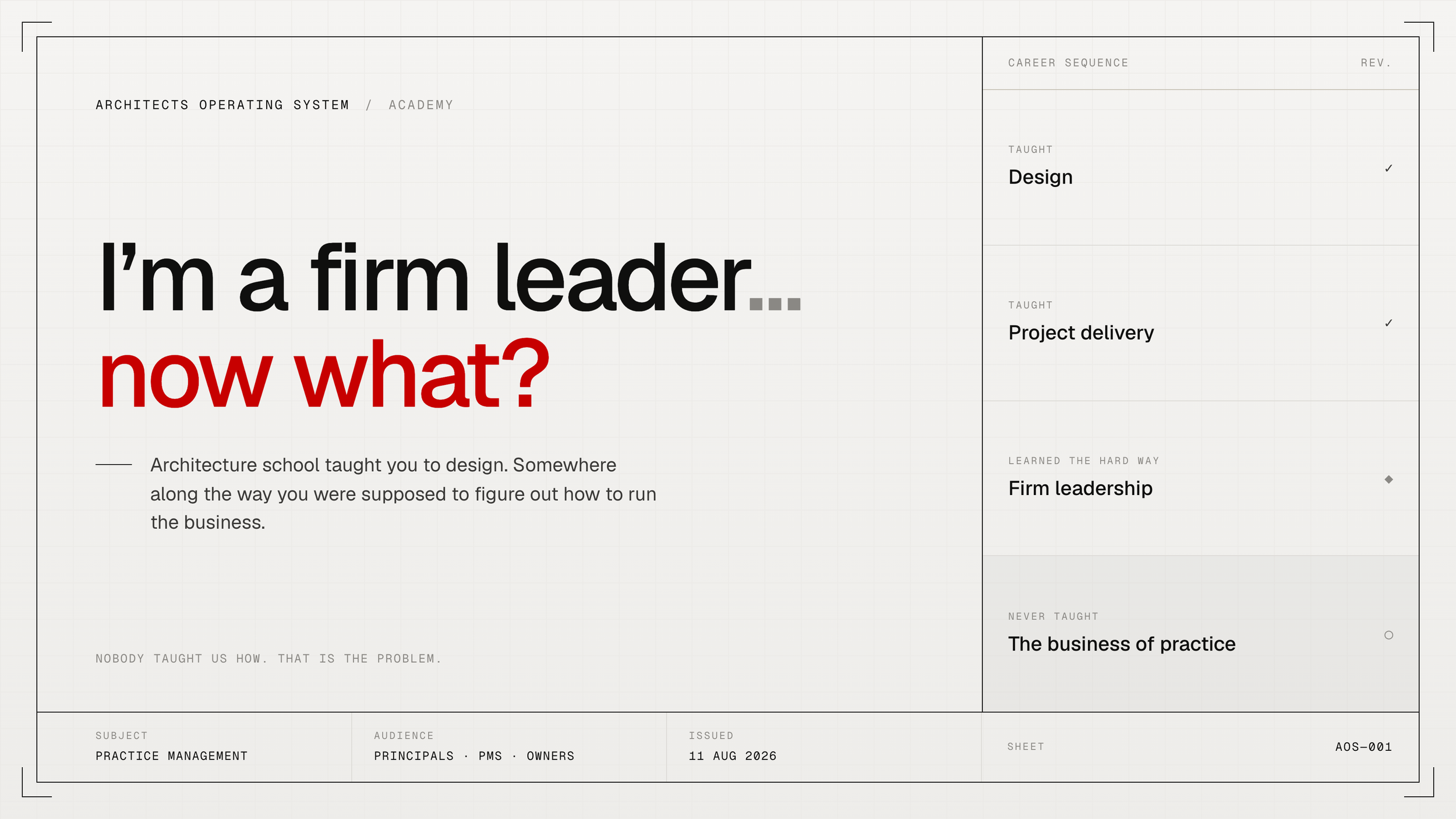
Architecture school didn’t teach me how to run a business. My mentors didn’t teach me either. And for a long time, I accepted that as simply part of the profession. You learn to be an architect first, and somewhere along the way you are supposed to figure out how to run an architecture firm. The longer I have been in practice, however, the more I have questioned why we continue to accept that model.
At some point in an architect’s career, the job begins to change. You spend years learning how to design, communicate ideas, solve problems, coordinate consultants, manage projects, navigate codes, work with clients and lead teams. You develop confidence, earn responsibility and gradually become someone others look to for direction. Then one day, formally or informally, you become a firm leader.
And that is when an entirely new set of responsibilities shows up.
Suddenly, you are expected to understand whether your billing rates are high enough, whether your projects are profitable, how much work should be in the pipeline, whether the firm has the capacity to take on another project, when to hire, how much cash should be kept on hand, how to evaluate a new opportunity, how to compensate employees, how to build a business development strategy and which financial metrics leadership should actually be paying attention to.
You may have become a very good architect, but now you are being asked to help run a business.
For many of us, nobody ever taught us how.
Architecture School Prepared Me to Be an Architect
I have tremendous respect for architectural education. Architecture school taught me how to think critically, communicate visually, defend an idea, solve complex problems and see possibilities that might not be immediately obvious. Those lessons have served me throughout my career.
What architecture school did not teach me was how the economics of an architecture practice actually work.
I don’t remember spending much time learning about overhead rates, utilization, labor multipliers, project profitability, cash flow, backlog, accounts receivable, firm valuation, ownership transition or business development strategy. There was no semester devoted to understanding how a project fee translates into labor budgets, staffing decisions and ultimately profit.
To some extent, that is understandable. Architecture school is intended to teach architecture. The larger problem is that the profession has never developed a particularly reliable system for what happens next.
Instead, many architects learn the business of practice through observation, experience and trial and error. We watch the leaders ahead of us. We sit in meetings. We make mistakes. We underprice work, overcommit staff, chase projects we probably should have passed on, hire too early or too late, and eventually begin connecting the dots.
Over time, if we are paying attention, we start to understand how the business works.
It does not need to be this way.
My Mentors Were Learning the Same Way
This is not a criticism of the mentors who helped me throughout my career. I have learned an enormous amount from other architects, firm leaders and business owners, and many of those lessons have shaped the way I lead today.
The challenge is that many of my mentors learned the business side of architecture the same way I did. They learned through experience, instinct and years of accumulated lessons. In many cases, they knew what worked because they had lived it, but they did not necessarily have a framework for explaining why it worked or a system for intentionally passing that knowledge to the next generation.
As a result, the profession has repeated the same cycle for decades. Architects become project managers, project managers become principals, principals become owners, and each new generation is expected to gradually figure out the business side of practice for themselves.
I have increasingly come to believe that this is a problem.
It should not take 20 or 25 years of someone’s career to begin understanding the fundamentals of running a successful architectural practice. A newly promoted principal should not have to reconstruct the economics of an architecture firm from scratch. A project manager responsible for hundreds of thousands or even millions of dollars in professional fees should understand how those fees relate to staffing, labor budgets, revenue and profitability. An emerging leader should have some understanding of ownership before being invited to become an owner.
We can do better than telling the next generation, implicitly or explicitly, that they will eventually figure it out.
Becoming a Firm Leader Is a Different Job
One of the mistakes our profession makes is assuming that becoming a great architect naturally prepares someone to become a great firm leader. The two roles are certainly connected, but they require different skills.
As responsibilities grow, firm leaders must understand much more than design and project delivery. They have to develop competency in financial management, project profitability, staffing, utilization, business development, marketing, contracts, risk management, strategic planning, hiring, compensation, leadership development, client retention, firm culture, ownership, succession, forecasting and operations.
The difficult part is that most architects are not given time to stop practicing architecture while they learn all of this. They are expected to learn the business while actively running the business. They are still managing projects, serving clients, solving problems and leading staff while simultaneously trying to understand a financial statement or determine whether the firm has enough backlog to support another hire.
That is a difficult way to learn, and in many cases it is an unnecessarily slow one.
The Business of Architecture Should Be Easier to Understand
Running an architecture firm does not need to be mysterious.
There are financial metrics that matter. There are management systems that work. There are questions firm leaders should ask regularly and warning signs they should learn to recognize. There are repeatable processes that can improve project performance, staffing decisions, business development, financial management and leadership.
The problem is that this information is often fragmented, overly complicated or presented in ways that do not feel particularly relevant to how architects actually work.
Most small and mid-sized design firms do not need an MBA textbook sitting on the conference room table. They need practical tools that help them make better decisions in the middle of a busy week.
They need to understand what they should be looking at on Monday morning, how to tell whether a project is financially healthy, what their project managers should be reviewing, how to evaluate whether a new opportunity is worth pursuing, how to anticipate staffing needs several weeks into the future and how to know whether the firm is charging enough for its services.
Sometimes the solution is education. Sometimes it is a spreadsheet, a dashboard, a checklist, a meeting agenda or a decision matrix. The format matters less than whether the tool helps a leader understand the situation and make a better decision.
That idea became one of the foundations for Architects Operating System.
Why I Started Architects Operating System
Architects Operating System grew out of the lessons I wish someone had handed me much earlier in my career.
After decades in practice and years of firm leadership and ownership, I have accumulated tools, processes, questions, mistakes and management practices that have helped me better understand the business behind the architecture. Some of those lessons came from great mentors. Some came from other industries. Many came from making mistakes, asking questions and trying to understand why one project or business decision worked while another did not.
Eventually, I kept coming back to the same thought: Why should every architect have to learn all of this the hard way?
They shouldn’t.
AOS is my attempt to organize and share the practical business knowledge that architects and engineers need to build healthier practices. It is intended especially for sole practitioners, small firms, project managers, emerging leaders and principals who may not have access to sophisticated management systems, extensive business training or a deep bench of experienced firm leaders.
The goal is not to turn architects into accountants. The goal is to help architects become better business leaders.
That means helping them understand what the numbers are telling them, recognize problems earlier, make more informed staffing and project decisions, price their work appropriately, choose better opportunities, develop stronger teams and build firms that are financially sustainable.
Most importantly, it means creating practices that rely less on heroic individual effort and more on intentional systems.
Better Architecture Requires Better Businesses
Architects are trained to believe deeply in the value of design. I certainly do. But the longer I have practiced, the more convinced I have become that great design and a healthy business cannot be separated.
A firm that is financially unstable eventually struggles to invest in its people. A firm that consistently underprices its services eventually has to compromise somewhere, whether that means compensation, staffing, technology, professional development, design time or leadership capacity. A firm without effective management systems often asks people to work harder simply to overcome problems that better systems could have prevented.
Profitability, therefore, should not be viewed as being in conflict with great architecture. Profitability is one of the things that makes great architecture sustainable.
A profitable practice has choices. It can invest in its employees, technology and training. It can explore ideas and take calculated risks. It can weather economic downturns. It can compensate people appropriately, spend more time mentoring young professionals and give project teams the resources necessary to do thoughtful work.
Perhaps most importantly, a healthy business can create opportunities for the next generation of architects.
We Should Not Have to Wait 25 Years
I often think about what our profession could look like if architects began learning the fundamentals of practice management much earlier in their careers.
What if project managers understood project financials as well as they understood project schedules? What if emerging leaders understood firm economics before they became owners? What if principals had simple systems that allowed them to quickly understand the health of their firms rather than relying primarily on instinct? What if the lessons that currently take decades to accumulate could be organized, explained and passed along intentionally?
I believe our firms would be stronger. Our leaders would be better prepared. Our projects would be more profitable. Our employees would have greater opportunities. And ultimately, our profession would be healthier.
That is the opportunity I see with Architects Operating System.
I certainly do not have every answer, and no firm does. But I believe we can do a much better job of sharing what we have learned. Architecture is already a difficult profession. Every generation should not have to rediscover the business side of practice from scratch.
If you have recently become a principal, started your own practice, taken responsibility for managing a portfolio of projects or simply reached the point in your career where you are beginning to ask, “I’m a firm leader…now what?”—you are exactly who Architects Operating System was created for.
The goal is simple: build better leaders, build better businesses and ultimately build better architecture practices.
And maybe, if we do this well, the next generation will not have to wait 25 years to understand what we could have been teaching them all along.